

Connect as someone who is both a Campfire admin and a Ramp admin. Before you
start, set up your chart of accounts (including the default accounts
payable account bills post to), entities, departments, and tags in
Campfire, and connect your bank feed so payments can be matched.
Before you cut over
Skip this section if Ramp was never connected to another accounting system. Give yourself a few weeks. Rushing the cutover is the most common cause of unmatched payments and missing coding later.- Pick a transition date: the first day of your go-live month. Generate final statements from your old system through the last day of the prior month.
- Pay off open bills in Ramp (recommended). Approve and pay as many Ramp bills as you can before the transition, and pause creating new ones until Campfire is connected. This isn’t always possible, but every bill still open at cutover means manual payment work later (see the warning below). In-flight bills do not transfer automatically.
- Sync card transactions to your old system up to the transition date, and let any uncleared transactions clear first.
- Sync reimbursements to your old system up to the transition date.
- Export a backup from Ramp. The export a backup link is on Ramp’s Switch accounting providers screen (Accounting > Settings > Danger zone > Switch providers). Save your coded transactions and rules before disconnecting; large exports take a while, so do this ahead of your cutover call.
Connect Campfire
Open the Ramp settings
In Campfire, go to Settings > Connections >
Ramp and click New
Connection.
Create the connection
Enter a Title, set the Pull From date to your transition date, turn
on Use Ramp Migration Tool if you’re cutting over from another system,
and click Save.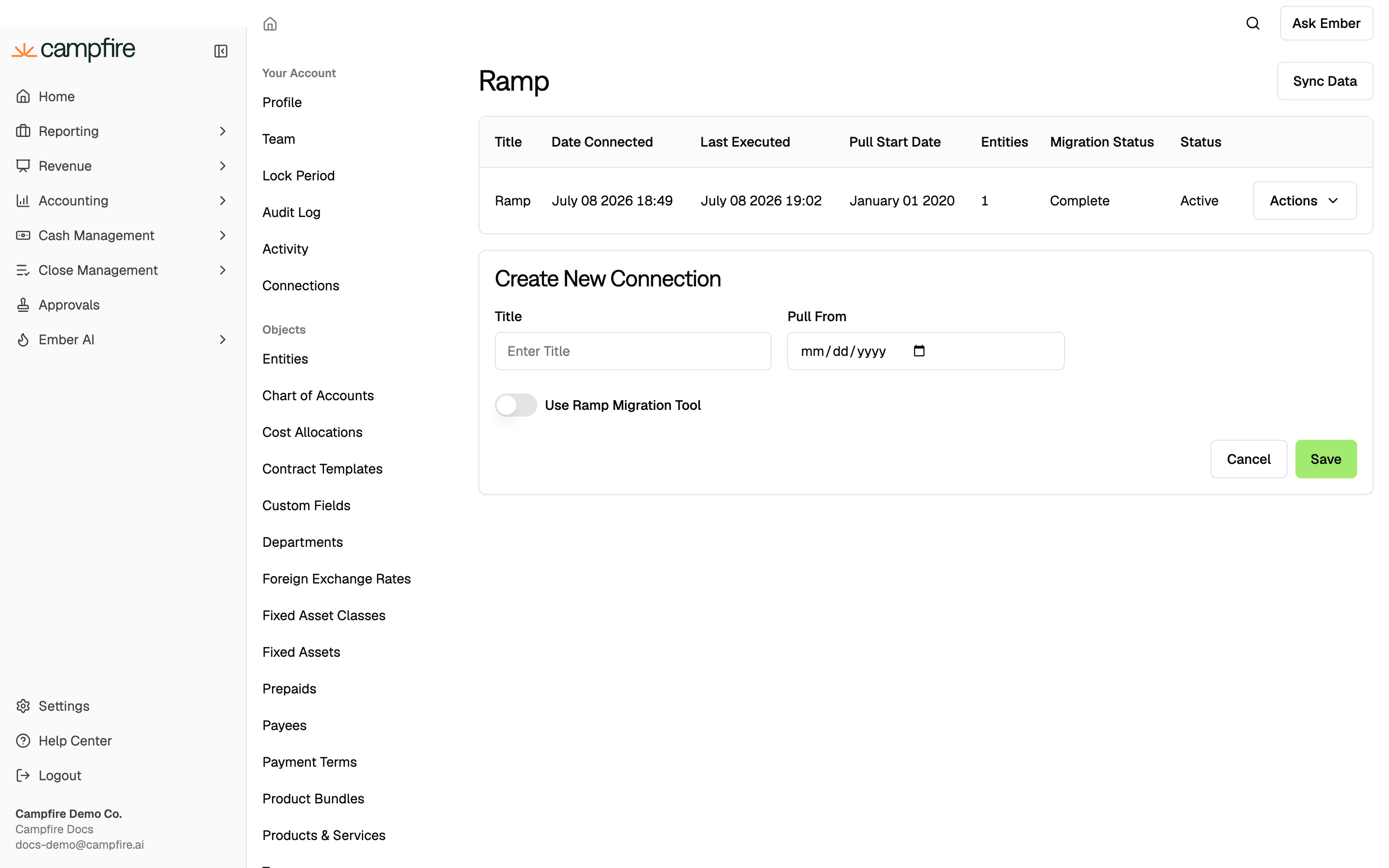
Authenticate with Ramp
Sign in to Ramp when redirected and authorize the connection. You return to
Campfire once it succeeds.
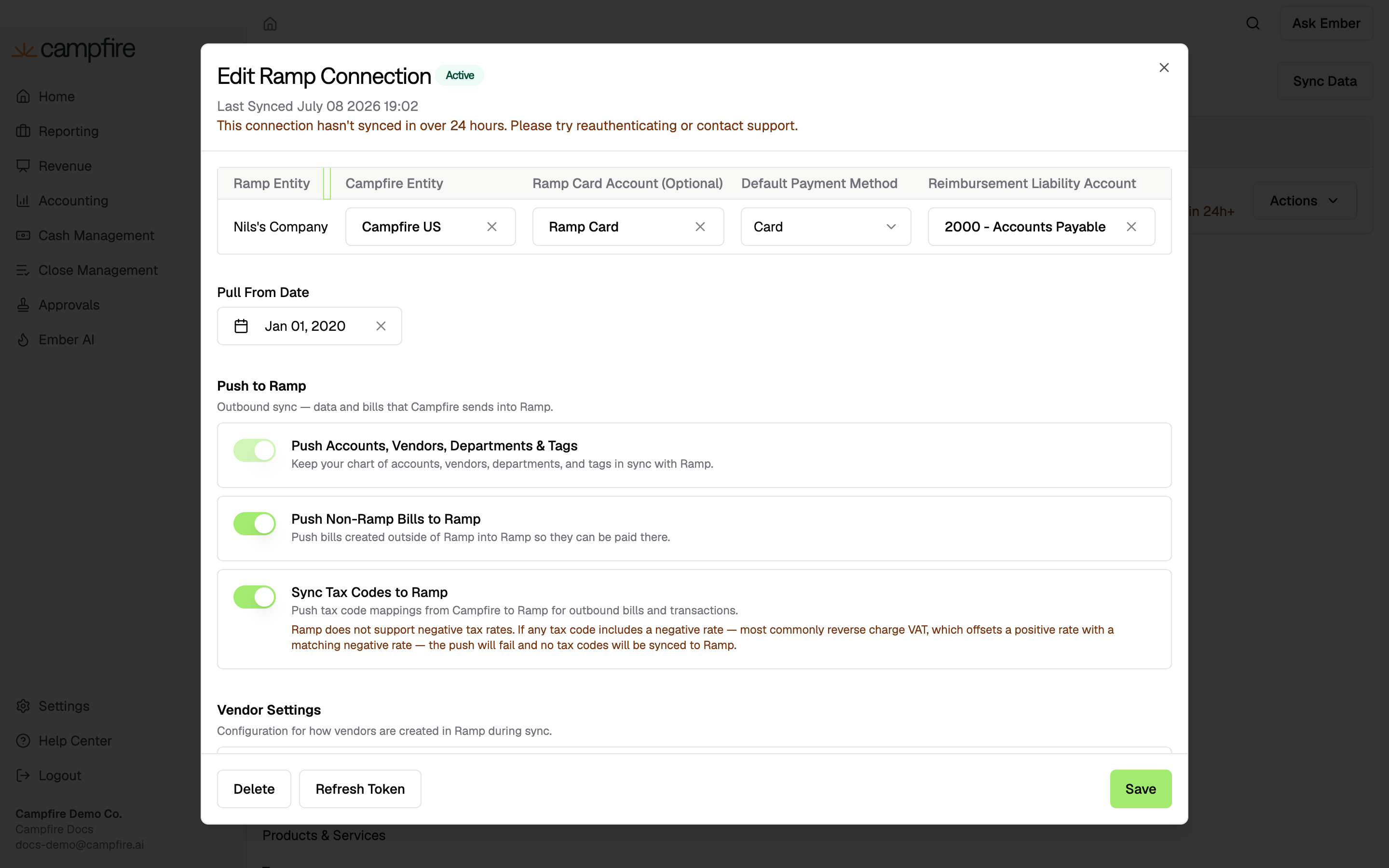
| Field | What it sets |
|---|---|
| Campfire Entity | The entity that Ramp activity posts to. |
| Ramp Card Account | The Ramp card liability account credited on card transactions. You can refine this later. |
| Reimbursement Liability Account | The account credited when reimbursements sync. This column appears once Create Bills from Reimbursements on Approval is turned on below. Use a dedicated account, separate from your main accounts payable and bill-payment accounts, so reimbursements are easy to reconcile. |
When to leave the migration tool off
Keep Use Ramp Migration Tool on for a normal cutover. Turn it off only when there is nothing to migrate:- You are already connected to Campfire in Ramp and are just deleting and recreating the connection (you have already migrated once).
- You were never connected to a previous accounting provider in Ramp, so there are no historical codings to carry over.
Sync settings
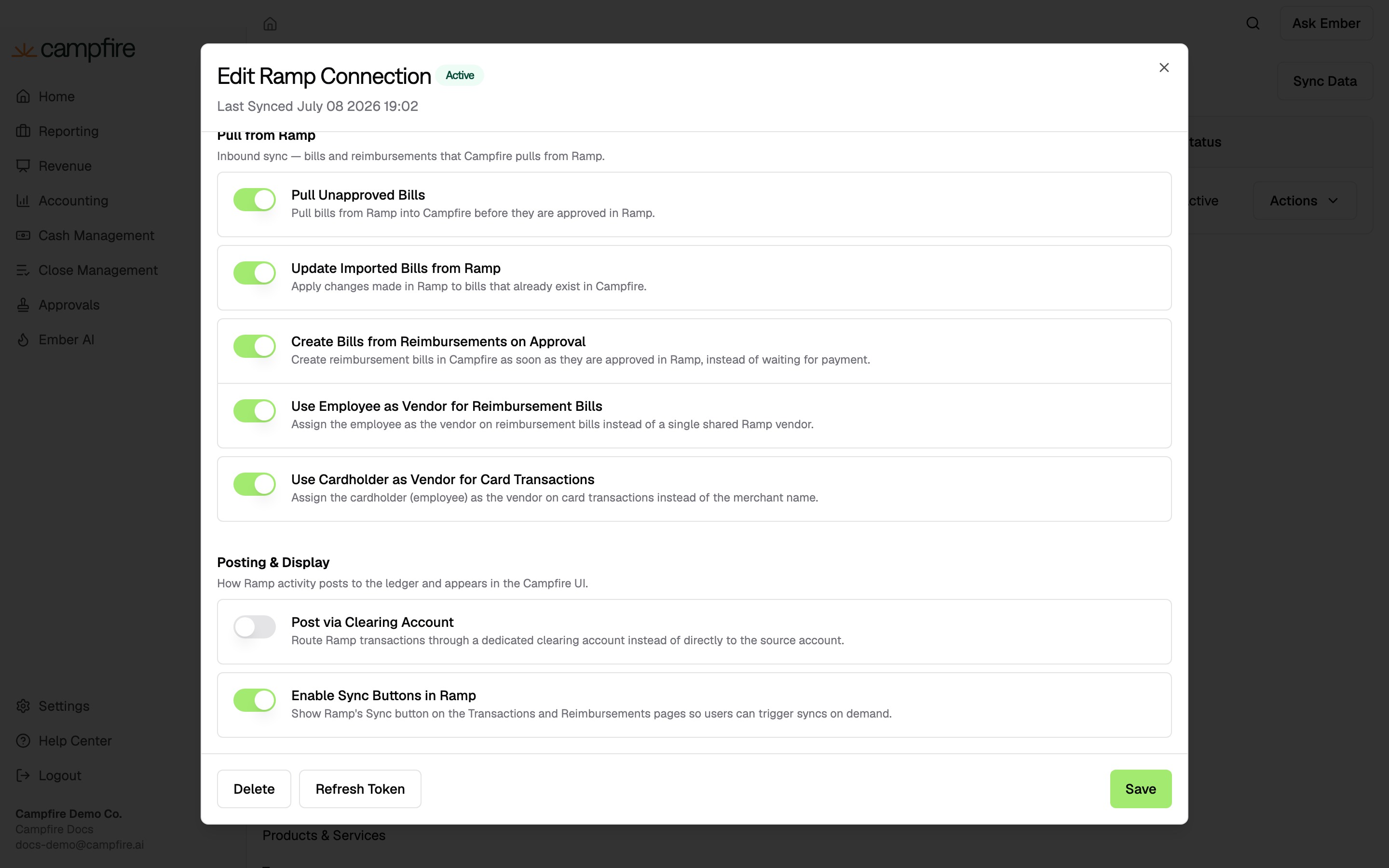
Complete these before running the switch in Ramp, so records sync with the right behavior from the first pull. Open the connection from Settings > Connections > Ramp; the settings are grouped into what Campfire pushes to Ramp, what it pulls from Ramp, and how activity posts.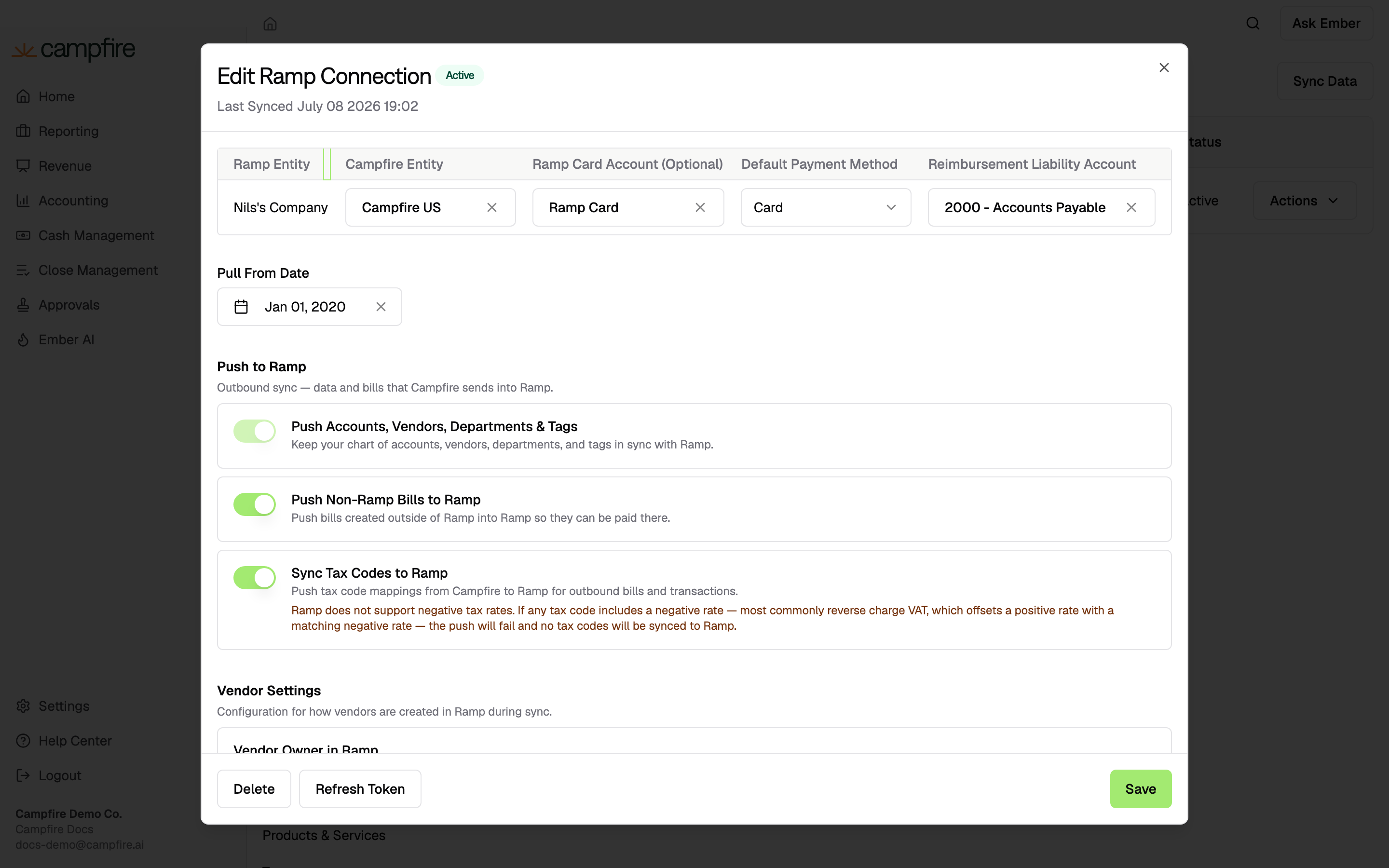
Push to Ramp
Data Campfire sends into Ramp so spend is coded there against your Campfire structure.| Setting | What it does | Recommended |
|---|---|---|
| Push Accounts, Vendors, Departments & Tags | Keeps your chart of accounts, vendors, departments, and tags in sync with Ramp so you can build coding rules in Ramp from Campfire data. Locked on once the connection runs through Ramp’s accounting integration (the standard path). | On (always on for standard connections) |
| Push Non-Ramp Bills to Ramp | Lets you push bills created in Campfire into Ramp to pay them there. Requires the setting above, and only one connection can have it enabled. | As needed |
| Sync Tax Codes to Ramp | Pushes tax code mappings to Ramp for outbound bills and transactions. Note: Ramp does not support negative tax rates; a tax code pairing a positive rate with a matching negative rate (most often reverse-charge VAT) makes the push fail with no tax codes pushed. | As needed |
| Vendor Owner in Ramp | The Ramp user set as owner and contact on vendors Campfire creates in Ramp. | Required to create vendors in Ramp |
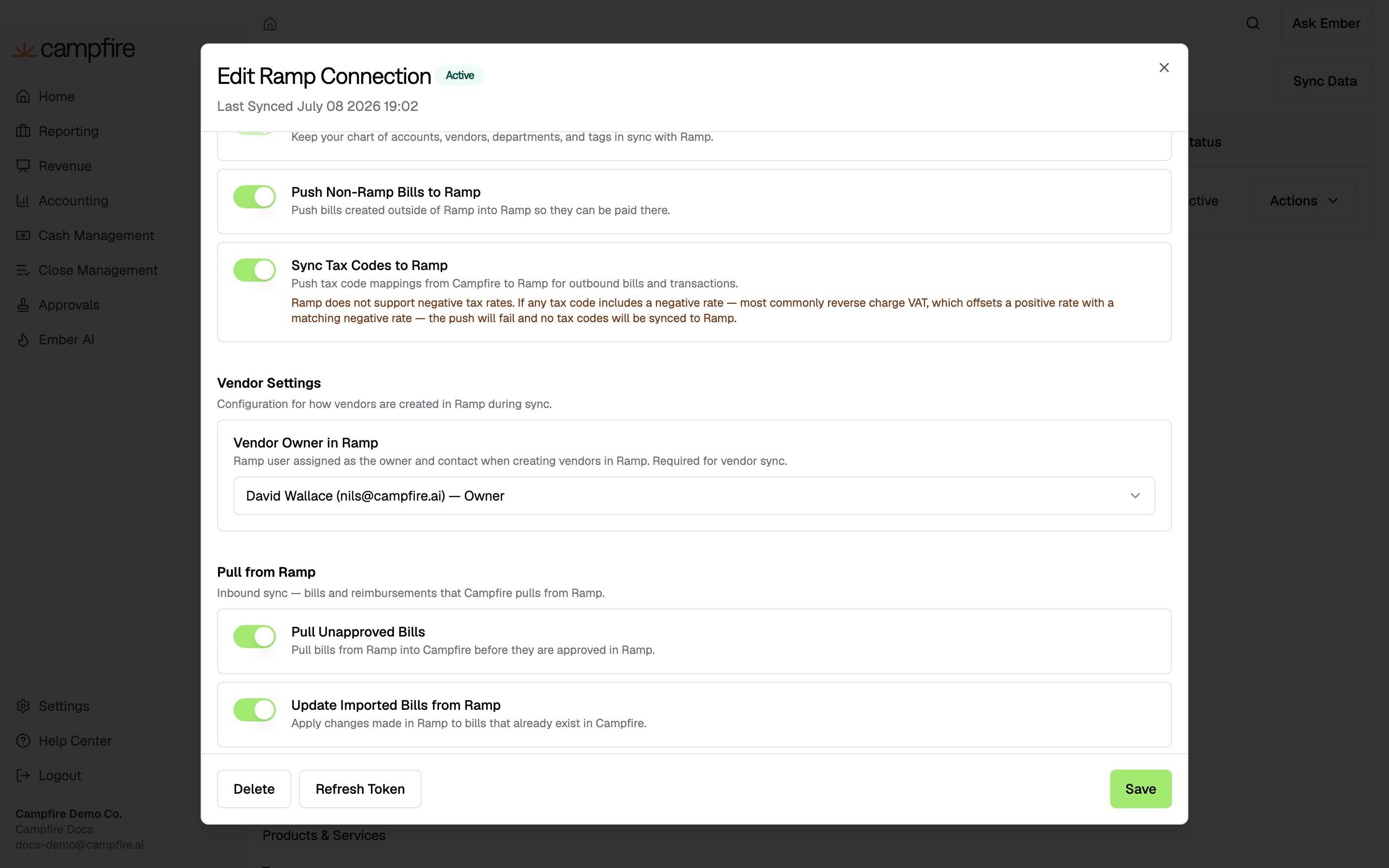
Pull from Ramp
Bills and reimbursements Campfire pulls from Ramp.| Setting | What it does | Recommended |
|---|---|---|
| Pull Unapproved Bills | Pulls bills into Campfire before they are approved in Ramp. | On if you want visibility before approval |
| Update Imported Bills from Ramp | Applies later Ramp changes to bills already in Campfire. Off by default, so Campfire edits to synced bills are protected unless you opt in. With it on, Ramp is the source of truth and Campfire edits are overwritten on the next sync (bills in locked periods are skipped, not changed). | On when Pull Unapproved Bills is on |
| Create Bills from Reimbursements on Approval | Creates reimbursement bills as soon as they are approved in Ramp, instead of waiting for payment. | On (accrual basis) |
| Use Employee as Vendor for Reimbursement Bills | Uses the employee as the vendor on reimbursement bills instead of a shared Ramp vendor. Available when the setting above is on. | As preferred |
Posting & Display
How Ramp activity posts to the ledger and appears in Campfire.| Setting | What it does | Recommended |
|---|---|---|
| Use Cardholder as Vendor for Card Transactions | Uses the cardholder (employee) as the vendor on card transactions instead of the merchant name. | As preferred |
| Post via Clearing Account | Books a bill payment to a clearing account the moment a bill is marked paid in Ramp, then you wash the clearing account with the bank transaction. The Clearing Account field appears once this is on. | Off (match the bank feed instead) |
| Enable Sync Buttons in Ramp | Shows Ramp’s Sync button on its Transactions and Reimbursements pages so your team triggers syncs on demand, instead of Campfire pulling automatically. | As preferred |
Switch Ramp over to Campfire
Start the switch
Under Danger zone, click Switch providers.Not migrating (no previous provider, or nothing to carry over)? Click
Disconnect on your prior system instead, and skip the remaining steps.
Review and begin
The Switch accounting providers screen recaps the three stages and
links export a backup if you haven’t taken one. Click Disconnect &
begin switching. Ramp notes some features are unavailable until the
switch completes, so run it outside the working day.
Connect Campfire by API key
Choose the API key option to connect Campfire. Do not use the Use
another accounting provider dropdown, or the migration tool will not run
and you will have to rebuild rules by hand.
Map and review your fields
Ramp maps your existing fields (category, class, customer, vendor) to your
Campfire accounts, departments, and dimensions, and re-codes your recent
unsynced Ramp transactions to match. Review the matched, skipped, and
needs-review groups, then click Mark as ready.
The mapping step re-codes your unsynced Ramp transactions (Ramp maps up
to the past year) to your Campfire accounts, departments, and dimensions.
If you skip it, those transactions import with no coding and post blank,
and you cannot re-run the mapping afterward. Complete every field group
before you finish.
Verify the connection
The connection carries two separate statuses, and both matter:| Status of | Values | What they mean |
|---|---|---|
| The connection | Pending Sync → Active, or Needs Reauthentication | Whether Campfire can reach Ramp and has synced |
| The migration | Uploading → Ready to Migrate → Complete | Where the migration-tool handshake stands (only with Use Ramp Migration Tool on) |
- Your chart of accounts, vendors, departments, and tags appear in Ramp.
- A test transaction flows from Ramp into Campfire with the right account, entity, and department.
- If you migrated: spot-check a handful of re-coded transactions, and review the bank-feed matches on CSV-migrated bills (they’re matched but not auto-applied).
- Click Sync Data to pull immediately instead of waiting for the next cycle (the button then waits 2 minutes before it can run again).
Resetting or rolling back
If the connection was set up incorrectly, or the migration ran with the wrong mappings, you can go back:- Roll back to your previous provider. Reconnect the previous accounting provider in Ramp. Ramp restores the prior transaction codings and accounting rules, so you can correct the setup and run the migration again. Field mappings and workflows added after the switch are not restored.
- Reset the Campfire connection. If only the Campfire side is wrong (entity mapping, accounts), delete the connection in Campfire and recreate it. Since the migration has already run once, leave Use Ramp Migration Tool off on the recreated connection.
Keeping the connection healthy
If a connection’s access to Ramp expires or is revoked, it shows Needs Reauthentication and stops syncing until you reconnect it. Reconnect from Settings > Connections > Ramp; a production connection re-runs the Ramp sign-in. Syncing resumes once it succeeds, and the next cycle catches up on anything still inside the automatic lookback windows (roughly 30 to 60 days depending on record type; see the overview). If the connection was down longer than that, use Ramp’s Sync button on the aged-out records or contact support.FAQ
Can I run Ramp with Campfire and my old system at the same time?
Can I run Ramp with Campfire and my old system at the same time?
No. Ramp syncs to a single accounting system, so you must cut over to
Campfire. Run the migration tool to carry your coding rules across;
connecting without it resets them.
What happens to my historical Ramp transactions?
What happens to my historical Ramp transactions?
Transactions already synced to your old system stay there; that system
remains your record for pre-cutover activity. Ramp’s mapping step re-codes
your recent unsynced transactions (up to about a year back) to Campfire
accounts, and anything older can be brought in later with Ramp’s Sync
button.
The migration didn't preserve my rules.
The migration didn't preserve my rules.
This happens when Campfire is connected through the Use another accounting
provider dropdown instead of the API key option. Reconnect your
previous provider to restore the codings, then reconnect Campfire using the
API key option so Ramp’s migration tool runs.
My historical transactions came in with no coding.
My historical transactions came in with no coding.
The mapping step in Ramp was skipped or left incomplete, so those
transactions posted blank. Reconnect your previous provider to restore the
codings, then run the migration again and complete every field group before
finishing.
Related
Overview
What syncs, how it runs, and how records post.
Bills & bill pay
Bills in and out of Ramp, payments, vendor credits, and clearing accounts.